Make Yourself a Priority SVG Cut File
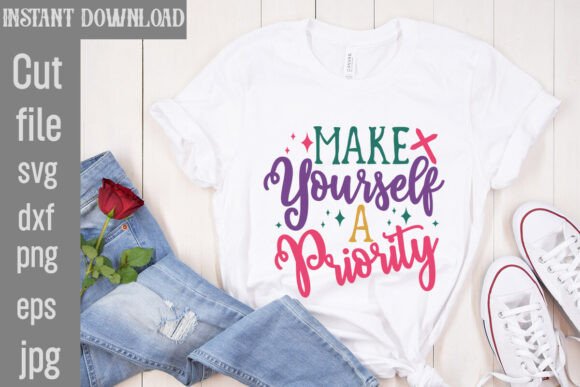
As an embroidery designer who’s stitched over 300 client projects—from boutique baby onesies to custom church event apparel—I opened Make Yourself a Priority SVG Cut File expecting warmth, clarity, and quiet strength. What I found was a clean, centered composition: soft serif lettering with gentle curve emphasis on “priority,” subtle cross motif tucked into the “O,” and balanced negative space. It doesn’t shout—it invites. That matters deeply when translating a digital file into a machine embroidery design meant for real fabric, real wear, and real people holding something meaningful in their hands.
I tested it first on a medium-weight cotton twill tote bag—exactly the kind my local gift shop orders for women’s ministry events. The phrase “Make Yourself a Priority” landed differently here than on screen: stitched in ecru thread on oat-colored fabric, it read as calm affirmation—not self-help cliché, but quiet intention. That shift from graphic to embroidered is where many faith-based SVGs falter. This one holds up. The letterforms are wide enough to avoid stitch crowding, the cross element is large enough to register at 3.5" width, and the overall layout avoids tight kerning that would vanish under satin stitch.
This design thrives in contexts where emotional resonance matters more than flash: nursery wall hangings, linen tea towels for new moms, lightweight cotton aprons for small-batch bakeries, or unstructured sweatshirts for retreat centers. It reads beautifully at 3–4" wide—ideal for left-chest placement on tees, upper-back embroidery on hoodies, or center-front on baby blankets. As a machine embroidery design, it leans into simplicity without sacrificing presence. There’s no excessive scrollwork, no fragile flourishes, no overlapping layers that demand precise alignment. That makes it forgiving for small shop product runs and reliable for Etsy seller consistency.
Where it needs thoughtful handling? On stretchy fabrics like jersey knits or ribbed cuffs—especially for custom apparel. The straight-line structure of the text means any fabric distortion will pull letters slightly out of alignment. I recommend testing on scrap knit with tear-away + cutaway stabilizer combo, and reducing density by 10% if your machine tends toward heavy fill stitch. Also, avoid placing it directly over seams or curved surfaces like cap fronts unless you’re using a cap frame and have confirmed hoop clearance—those tight corners on the cross detail can snag or distort if hooped too aggressively.
On dark fabric? It shines—but only with high-contrast thread. I ran it in charcoal gray on navy chambray, and the readability held. In white on black? Crisp, but only with proper topping (a light water-soluble stabilizer layer). Without it, the fill stitch can sink into nap or texture. For baby embroidery, stick to soft poly-cotton blends and skip metallic threads—the design’s sincerity gets lost in sparkle anyway. And while it works well as an embroidered patch, don’t scale it below 2.25": the inner curve of the “O” and cross junction lose definition, making the symbol feel vague rather than intentional.
What surprised me most was how well Make Yourself a Priority SVG Cut File translated to commercial context. I mocked it up on a mockup pack for a women-led wellness brand—and it didn’t look like generic religious decor. It looked like part of their voice. That’s rare. Too many Christian SVG bundle files default to ornate borders or overt iconography that limits versatility. This one breathes. It supports brand consistency without demanding it. Whether you're building a craft business around mindful living, stocking a small shop with curated faith-based goods, or designing personalized gifts for baptisms and graduations, this design carries weight without weighing down.
Visually, it builds trust. Customers scanning your Etsy listing or booth table respond to clarity—not clutter. The phrase is instantly legible, the sentiment accessible across ages, and the execution feels handmade, not mass-produced. That perception lifts perceived value: a $38 embroidered sweatshirt with this design feels considered, not templated. It also photographs cleanly for social media and printable mockups, which matters for digital-first sellers.
A few practical notes before you stitch:
- Always test on scrap fabric first—especially if pairing with textured weaves like canvas or terry cloth.
- Check thread color contrast against both light and dark backgrounds. A warm taupe reads differently on ivory vs. heather gray.
- Review stitch density in your embroidery software. If the fill areas feel heavy for your fabric weight, reduce density by 5–8%.
- Confirm hoop size—this design fits comfortably in a 4"x4" hoop at standard sizing, but verify before nesting multiple pieces.
- Inspect small details in your software preview: the cross junction inside the “O” should be fully connected, not clipped or pixelated.
- Test in black-and-white mockups to assess visual hierarchy—does the phrase dominate, or does the symbol distract?
- Use proper stabilizer: medium-weight cutaway for stable wovens, tear-away + topping for knits or napped fabrics.
- Confirm licensing before selling finished items or bundling the file—you’ll need to review terms from the original Christian SVG bundle source, as usage rights vary across digital embroidery file providers.
In short: Make Yourself a Priority SVG Cut File isn’t just another T-Shirt Designs graphic. It’s a quietly confident design asset that earns its place on garments, home goods, and heartfelt gifts—not because it’s loud, but because it’s legible, adaptable, and emotionally grounded. For designers, creative entrepreneurs, and makers who care how meaning lands in thread and fabric, it’s a thoughtful addition to your working library. Just remember: even the best embroidery file depends on your judgment. Stitch intentionally. Test generously. And yes—make yourself a priority while you’re at it.