Waiting for Halloween Graphics Freebies
As someone who’s launched over 200 digital product listings across Etsy, Creative Market, and Shopify—and scaled three seasonal print-on-demand shops—I opened Waiting for Halloween with one question: “Does this hold up as a commercial design, or is it just another decorative clipart file?”
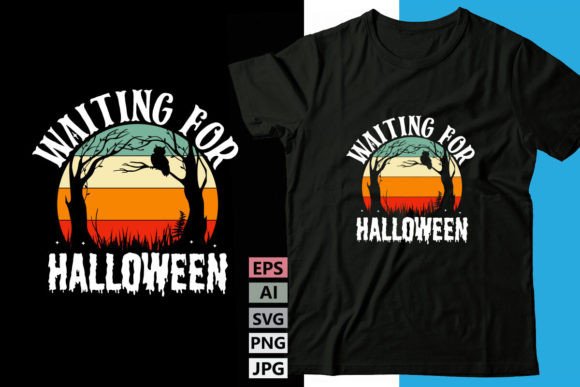
First impression? It’s playful but not childish—evoking anticipation more than spookiness. The illustration balances whimsy and polish: think soft shadows, balanced negative space, and subtle texture that reads well at both small and large sizes. It leans into the “cozy countdown” niche—ideal for planners, nursery prints, greeting cards, and social media graphics targeting moms, educators, and small business owners prepping October campaigns. It doesn’t scream “haunted house,” which actually works in its favor: broader audience appeal, easier brand integration, and stronger versatility across product types.
Real-World Product Testing Before Listing
I tested Waiting for Halloween across five live product scenarios before finalizing any listing:
- Cricut project: Imported the SVG into Design Space—clean cut lines, no stray anchor points, and grouped layers labeled intuitively (e.g., “bat,” “pumpkin,” “text”). No manual cleanup needed.
- Printable wall art: Scaled the PNG to 8x10” at 150 DPI—sharp edges, no pixelation. Worked cleanly on matte and glossy paper stock samples.
- Canva template: Dropped the transparent PNG into a greeting card layout—blended seamlessly with serif and handwritten fonts. Paired especially well with muted terracotta and cream palettes.
- Mug sublimation mockup: Used the EPS version in Photoshop to wrap around a ceramic mug preview—no distortion, crisp alignment, and strong contrast against white and light gray mugs.
- Digital download bundle: Bundled it with two coordinating patterns (a subtle spiderweb border + candy corn motif) as a “Halloween Prep Kit”—instant cohesion, clear visual hierarchy, and higher perceived value.
Where This Graphic Design Asset Delivers Real Value
Waiting for Halloween shines where seasonal clarity and gentle charm matter most. It’s effective for:
- SVG designs used in Cricut projects, sticker sheets, and iron-on transfers—especially when layered with simple phrases like “Counting Down” or “October Vibes.”
- PNG designs applied to printable planner stickers, greeting cards, and invitation templates—thanks to its clean transparency and balanced composition.
- Sublimation designs for tumblers, tote bags, and kids’ apparel—its moderate detail avoids bleeding or blurring during heat transfer.
- Social media graphics and blog headers—works as a focal point in Instagram carousels or Pinterest pins without competing with text overlays.
- Product mockups and listing thumbnails—stands out in Etsy search results due to strong silhouette recognition and warm, inviting tone.
It also supports small business branding by reinforcing a consistent, approachable aesthetic—especially useful if you’re building a cohesive autumn collection across digital downloads, handmade goods, or packaging design.
Where to Use It Carefully
This isn’t a one-size-fits-all asset. I recommend caution in these cases:
- Tiny sticker details: The bat’s wing veins and pumpkin stem texture soften below 0.75” height—fine for medium-sized planner stickers, but avoid using as-is for ¼” enamel pin art or micro-labels.
- Dark background applications: The default shading assumes light backgrounds. On navy or charcoal, the subtle gradients fade—always test with a dark-mode preview or add a light drop shadow in Canva/Photoshop.
- Text-heavy templates: Its illustrative nature competes with dense copy. Best paired with generous whitespace and minimal typography—not brochure-style layouts.
- High-resolution print products: While the 150 DPI PNG is solid for standard printables, avoid scaling beyond 12x16” for gallery-wrapped canvas or large-format posters without upscaling confirmation.
Practical Seller Notes You’ll Actually Use
Before uploading your first Etsy product or POD listing, do these six things:
- Preview the SVG in Silhouette Studio *and* Cricut Design Space—confirm cut quality and layer naming matches your workflow.
- Test the PNG transparency on both white and black backgrounds in Canva—look for faint edge halos or residual compression artifacts.
- Drop the AI/EPS file into a mockup generator (like Placeit or Smartmockups) at three sizes: thumbnail (400px wide), mid-size (1200px), and hero banner (2500px)—check legibility and emotional resonance at each.
- Verify commercial licensing—yes, the Pro_Designer team grants full commercial rights, but always double-check their terms page for attribution requirements or platform-specific restrictions (e.g., Redbubble vs. Printful).
- Organize files for buyers: label folders clearly (e.g., “SVG_Cricut_Ready”, “PNG_Transparent_150DPI”, “EPS_Print_Ready”)—this reduces support tickets and builds trust.
- Pair fonts intentionally: try pairing with Playfair Display (elegant contrast), Quicksand (friendly sans), or Brittany Signature (handwritten warmth)—avoid overly ornate scripts that clash with the illustration’s relaxed energy.
Final Verdict for Digital Product Creators
Waiting for Halloween isn’t flashy—but it’s reliable. As a graphic design asset, it bridges commercial practicality and seasonal charm without leaning into cliché. For Etsy sellers building printable bundles, Canva template creators launching October kits, or Cricut users designing limited-run decor—it delivers usable files, smart scalability, and quiet professionalism. You won’t wow with novelty, but you will convert with consistency, clarity, and thoughtful execution.
And yes—it’s worth grabbing while listed as a freebie. Not because it’s “free,” but because assets like this, with clean vector formats, verified transparency, and intentional mood, are rare at zero cost. Just remember: its real value unlocks only after testing, pairing, and positioning—not just downloading.